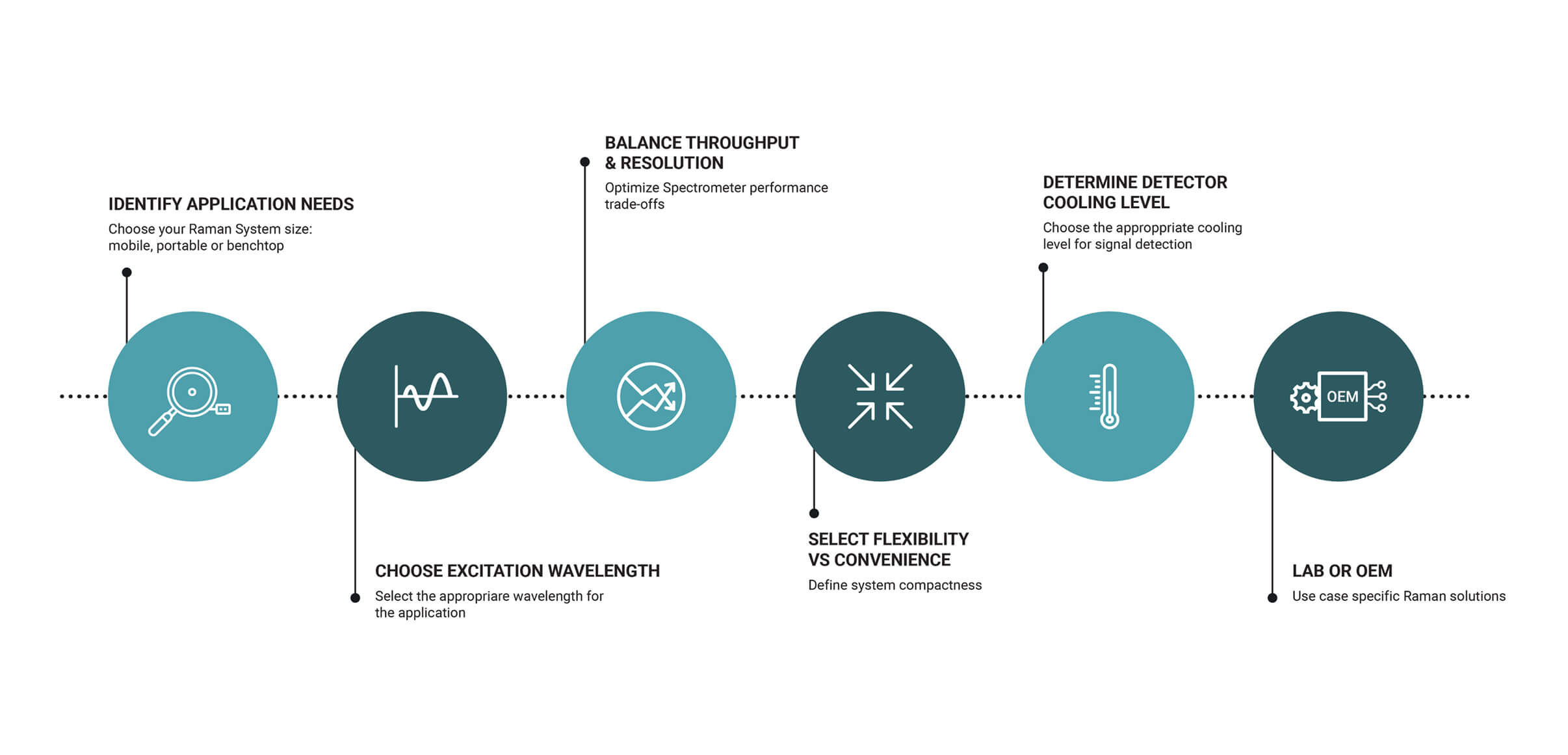
As every Raman application is unique, a one-size-fits-all spectrometer is no fit at all. By choosing the most appropriate bench size and the best excitation wavelength for your application, finding the optimum compromise between spectrometer throughput and spectral resolution, selecting the ideal balance between flexibility and convenience, and deciding on the detector cooling level that your signal needs, you can step by step match the Raman system to your application.
Features & Benefits
•
Match the Raman system to your application
•
Choices of excitation wavelength, throughput and resolution
•
Optimize detector cooling level for best signal detection
•
Select flexibility vs. convenience
Reliable, stable, and reproducible performance through robust design and testing.
WP Raman Systems Selection Process
Configuration Considerations
Choose the Right Raman Bench
Optimize Raman system size, performance, and integration to your goals
Raman applications span an ever-expanding range of use cases, from mobile identification in the field to medical diagnostics at point of care, from routine analytical work to advanced scientific research. Different use cases require a different balance of size, weight, spectral range, resolution, integration, and system cost. Wasatch offers four Raman platforms, from the pocket-size XS to the benchtop XL, enabling you to select the system architecture best aligned with your use case and deployment plans.
Optimize Raman performance for your sample and application
Raman scattering can, in principle, be generated using almost any excitation wavelength. The ideal wavelength, however, depends on balancing several Raman trade-offs, including autofluorescence, scattering efficiency, spectral range, detector sensitivity, laser size, power, and system cost. Rather than a single “best” wavelength, the optimal choice depends on your sample type, measurement priorities, and use case.
Optimize slit width and f/# for your Raman application
Spectrometer performance is fundamentally determined by throughput and resolution. Light collection efficiency scales with slit area and inversely with f/#², making low f/# designs especially valuable for fast Raman measurements. Wider slits further increase signal but reduce spectral resolution, creating the classic trade-off between throughput-and resolution. Configurable optical options allow you to select the best balance for your application – whether your priority is speed, sensitivity, or spectral detail.
Balance probe flexibility, automation, and compact system design
The ideal Raman system architecture depends largely on the application, sample, and use case. Some applications require flexible probe positioning relative to the sample, other use cases need a compact, integrated, design for portability. Wasatch offers multiple integration levels so you can choose the right balance of flexibility, automation, and footprint for your application.
Match cooling, sensitivity, size, and power to your application
Raman detector technology has evolved dramatically. While early Raman systems often depended on liquid nitrogen cooled cameras for long integrations, modern Raman applications achieve excellent results with moderately cooled or even uncooled sensors. Detector choice is no longer just defined by cooling level alone. Expected integration time and signal levels, spectral range, pixel size, detector sensitivity, system complexity, power requirements and budget are equally important considerations. Wasatch offers multiple detector classes so you can select the most practical performance level for your application,
Whether a researcher interested in productizing your ideas with a spin-off, or a developer trying to shorten product development cycles, Wasatch’s “OEM inside” design philosophy helps to protect your time and development investment. At the heart of every laboratory-ready Raman system is the same OEM bench used in final products. Laboratory systems simply add mechanical and electrical features to ensure safety compliance, and simple out of box operation. This means that the spectra, calibration data, and analysis methods you develop during the feasibility and validation stage will transfer directly into your final product, without having to start over.
Misty Johnson is responsible for taking care of our grating customers at the Logan, Utah, facility. She has been a member of the Wasatch Photonics team since 2009. By understanding her customers’ needs and goals, as well as the current grating market, Misty is able to provide a superior level of customer support. As Account Manager, she acts as a liaison between customers and Wasatch Photonics’ manufacturing department making sure that the lines of communication are always open.
Customer support is an integral part of Wasatch Photonics commitment to customers. Whether you are in the market to purchase a single grating, inquiring as a distributor, or purchasing large volume, Misty will guide you seamlessly through the custom design process. Misty strives to build trust and strong long term relationships with Wasatch Photonics customers. She brings 20 years’ experience as customer support manager from a number of manufacturing and service companies.