For 25 years, Wasatch Photonics has designed, manufactured, and supplied gratings, with over 250,000 integrated into customer products, demonstrating proven reliability.
Our VPH transmission gratings provide high efficiency, low polarization dependence, and uniform performance across broad bandwidths and large clear apertures in a robust, field-tested design. Wasatch multiple patented technologies enable us to offer you flexible, application-specific grating solutions.
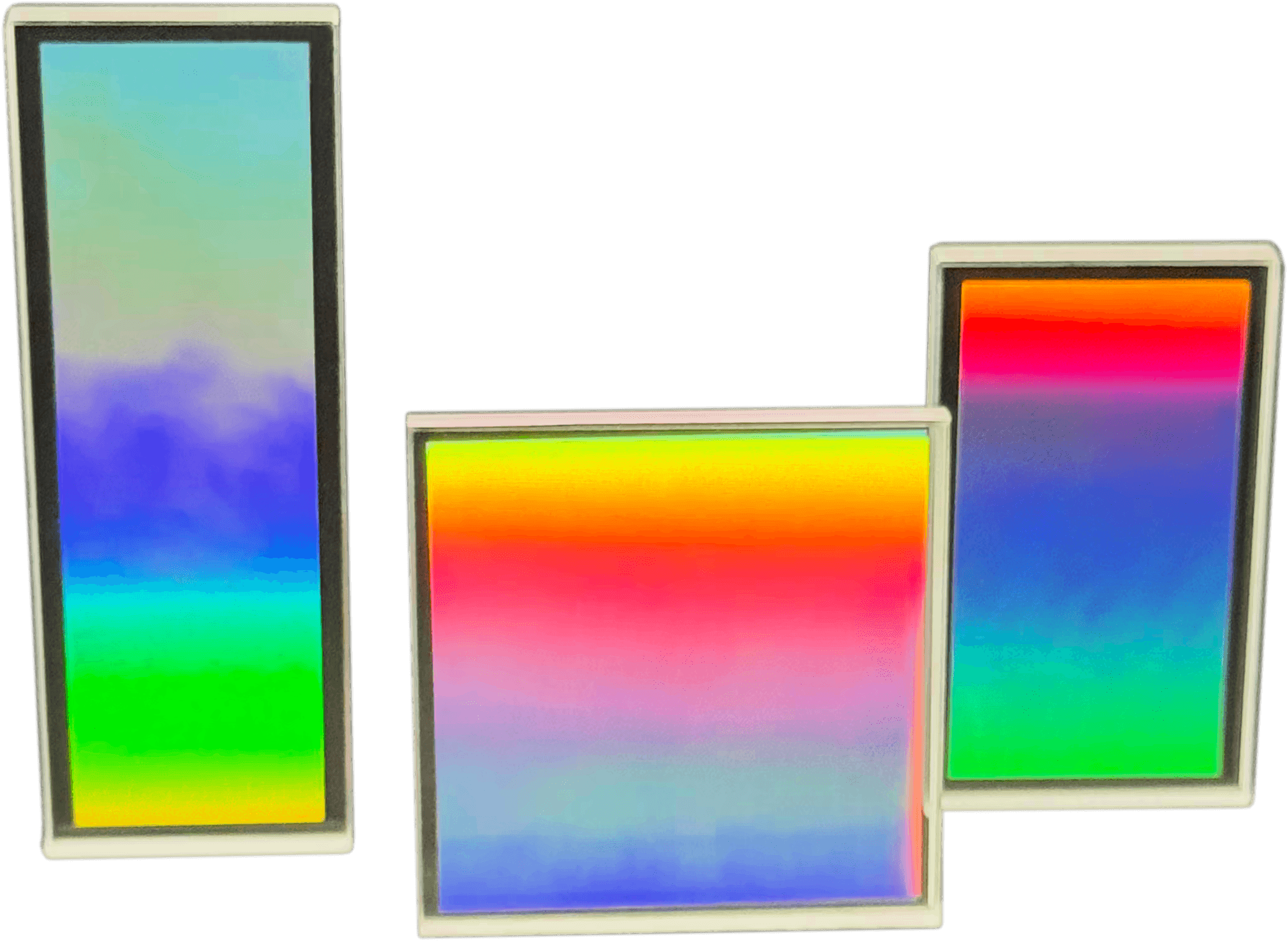
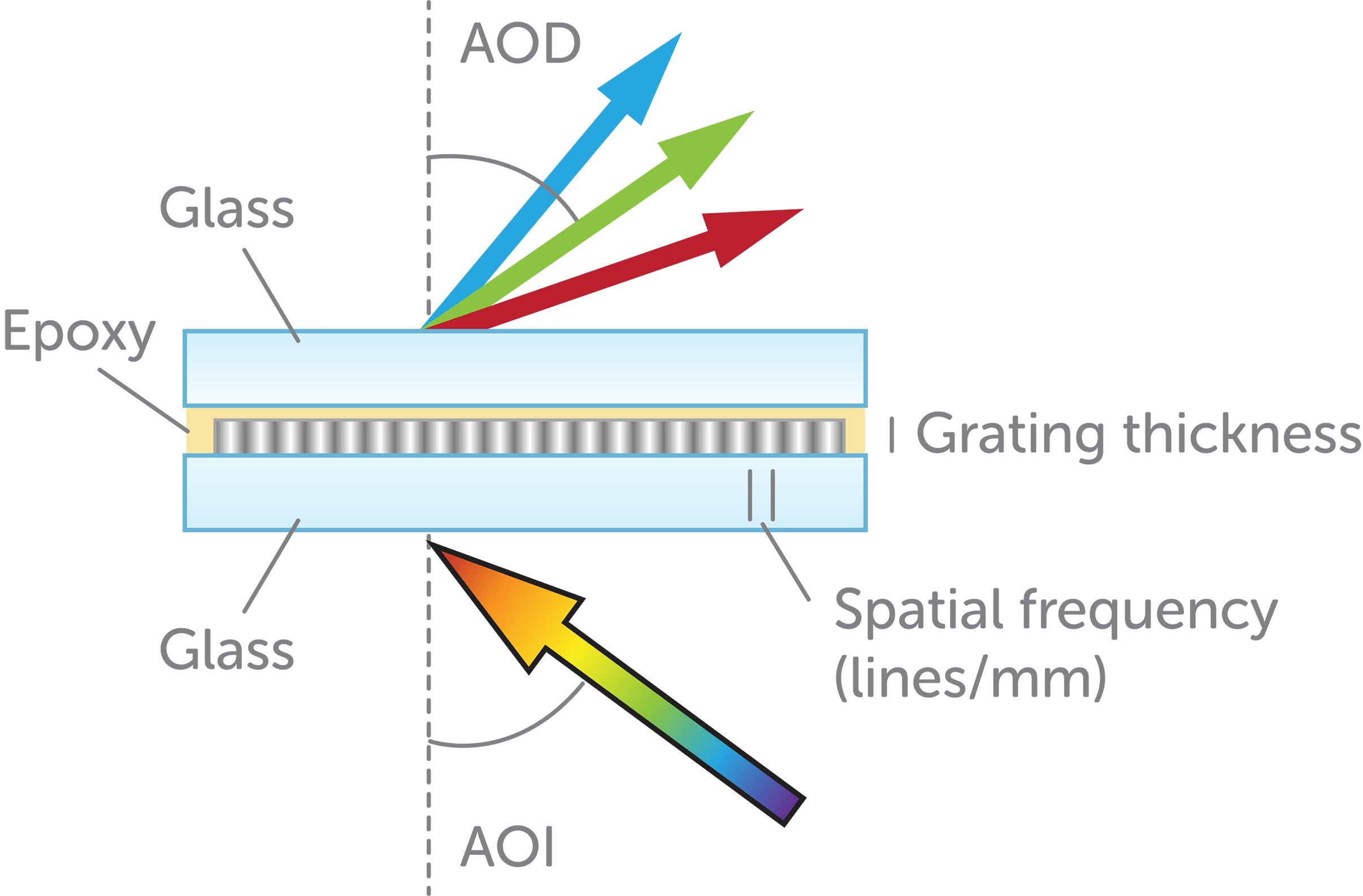
Volume phase holographic (VPH) gratings are created by holographically recording a periodic refractive index pattern in dichromated gelatin sealed between optical windows. Their flexible manufacturing process enables cost-effective customization of groove density, bandwidth, polarization sensitivity, and other parameters for each application.
ISO 9001 : 2015 production of all original VPH gratings
Our ISO-certified new product development process ensures all new grating designs are designed for manufacturing from product concept and are manufacturable in a highly scalable manner with the highest quality. Wasatch presently delivers approximately 20,000 gratings per annum with RMA rates significantly less 1%.
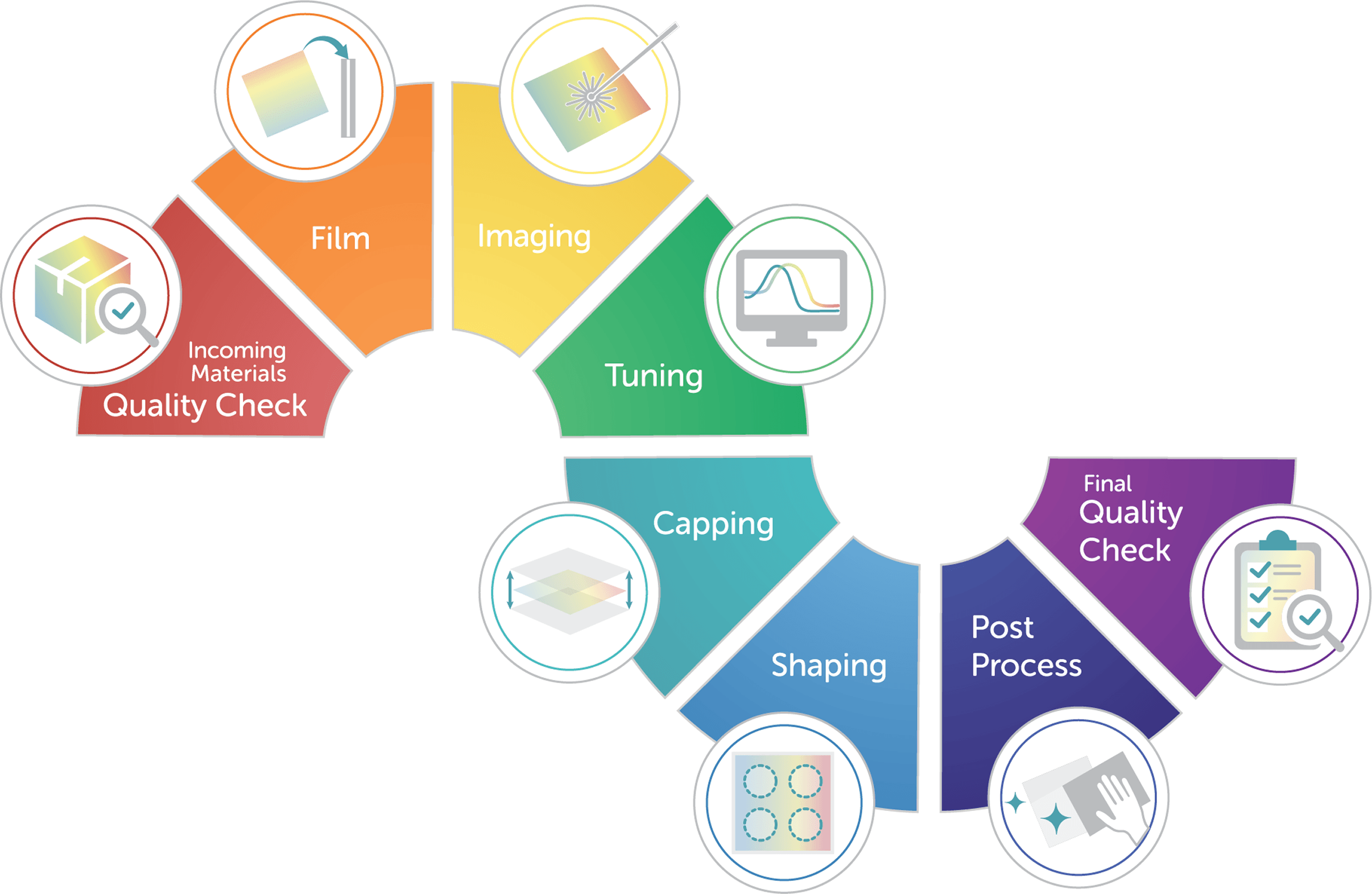
VPH gratings are made through multiple specialized steps, with dedicated in-process QC to ensure consistent, high-quality performance. Unlike competing technologies, no replication is used, so our gratings avoid common performance degradation. All production is handled in-house, except for polishing and AR coating, which are done by leading industry partners.
At Wasatch Photonics, VPH transmission grating technology drives everything we do. Offering superior optical performance, design flexibility, robustness, and consistency, VPH gratings outperform reflective ruled gratings and are ideal for applications such as laser pulse compression, spectroscopy, optical coherence tomography, and astronomy.
Each Grating is an Original
We manufacture high-quality VPH transmission gratings by imaging periodic high- and low-index structures into dichromated gelatin between optical windows. Originally developed by IBM for holographic barcode scanners, the technique now serves optical instruments and telecommunications.
Producing gratings from originals ensures consistent, long-term performance without replication wear, and allows cost-effective customization of groove density, bandwidth, polarization sensitivity, and other parameters over multiple design iterations.
High Dispersion
VPH gratings offer higher line densities than ruled gratings (150–~5000 lines/mm) with low ghosting and scatter, suitable for applications from broadband NIR hyperspectral imaging to high-resolution atomic spectroscopy. Our manufacturing process allows easy customization of line density and operating wavelength.
More Compact, Flexible Optical Designs
Transmission gratings enable more compact optical designs, including Littrow configurations, and offer greater geometry flexibility for systems like pulse compressors or spectrometers. Systems using Wasatch Photonics VPH gratings are typically smaller, lighter, easier to align, and more cost-effective than those with conventional reflection gratings.
Angle Tuning
VPH transmission gratings diffract light using stacked layers of sinusoidally varying index. This stack creates a resonant structure that can be tuned in center wavelength simply by varying the angle of incidence (AOI) by up to ~10°. This allows a single grating to be angle-tuned to study spectral features of interest in different ranges, a common technique in astronomy. In fact, several very large gratings on rotating stages may be used in a single large scale telescope to cover the visible through near infrared continuously.
Excellent Durability
The active layer of a VPH grating is sealed between two substrates, creating a robust component with excellent thermal and environmental stability. Many gratings have performed reliably for 10+ years, including near-cryogenic conditions, making them suitable for applications from laser pulse compression and spectroscopy to biomedical devices and astronomy.
Size & Substrates - Big & Small
Unlike delicate ruled reflective gratings, which cannot be cleaned without damage, encapsulated VPH gratings can be handled and cleaned like standard glass optics. This makes them more manufacturing-friendly and reduces costs throughout production and long-term use.
Each Grating is an Original
The transmissive, holographic design of our VPH gratings delivers high, smoothly varying diffraction efficiencies—>80% over 200–300 nm and >99% at a single wavelength under Bragg conditions—up to 40% higher than reflective surface relief gratings. Their performance can be accurately modeled during design and reliably manufactured. Encapsulation also allows high-performance, customizable anti-reflection coatings for further optimization.
Using our three patented design technologies, we optimize gratings for every application—from stock R&D gratings to custom OEM solutions—delivering uniform efficiency over bandwidths up to 200–300 nm.
Reduced Polarization Sensitivity
Surface relief reflection gratings show much lower and uneven efficiency for p‑ versus s‑polarization, especially at high line frequencies. VPH gratings are far less polarization-sensitive, with smooth, predictable responses. Our patented Dickson and HD designs allow polarization to be minimized or optimized for your application.
Grisms
A grism— a grating sandwiched between two prisms—disperses light while canceling beam deviations. It can provide straight-pass or enhanced dispersion beyond a grating alone, making it useful for imaging, astronomy, spectrally encoded confocal microscopy, and other applications.
No Ghosting, Low Scatter
Ruled gratings can produce “ghosts” from periodic errors, while VPH gratings can be designed to eliminate them. They also have 90% less stray light, excellent spatial uniformity, and very low transmitted wavefront error, all contributing to their high first-order diffraction efficiency.
Easy to Clean
Everyone knows never to touch a ruled, reflective grating, as they cannot be cleaned – every speck of dust or fingerprint must remain, as the scratching that would occur from “cleaning” would be worse than the contamination itself! In contrast, our encapsulated VPH gratings can be handled and cleaned like any other glass optical component, making them much more manufacturing-friendly and reducing cost at every stage, from build through long-term use.
Conclusion
Wasatch Photonics’ founders began producing VPH gratings in dichromated gelatin over 40 years ago, recognizing their performance, flexibility, and scalability from prototypes to volume production. Since then, we’ve focused on delivering the quality and consistency expected from an experienced supplier. Contact us to discuss your unique requirements.
Misty Johnson
Misty Johnson is responsible for taking care of our grating customers at the Logan, Utah, facility. She has been a member of the Wasatch Photonics team since 2009. By understanding her customers’ needs and goals, as well as the current grating market, Misty is able to provide a superior level of customer support. As Account Manager, she acts as a liaison between customers and Wasatch Photonics’ manufacturing department making sure that the lines of communication are always open.
Customer support is an integral part of Wasatch Photonics commitment to customers. Whether you are in the market to purchase a single grating, inquiring as a distributor, or purchasing large volume, Misty will guide you seamlessly through the custom design process. Misty strives to build trust and strong long term relationships with Wasatch Photonics customers. She brings 20 years’ experience as customer support manager from a number of manufacturing and service companies.