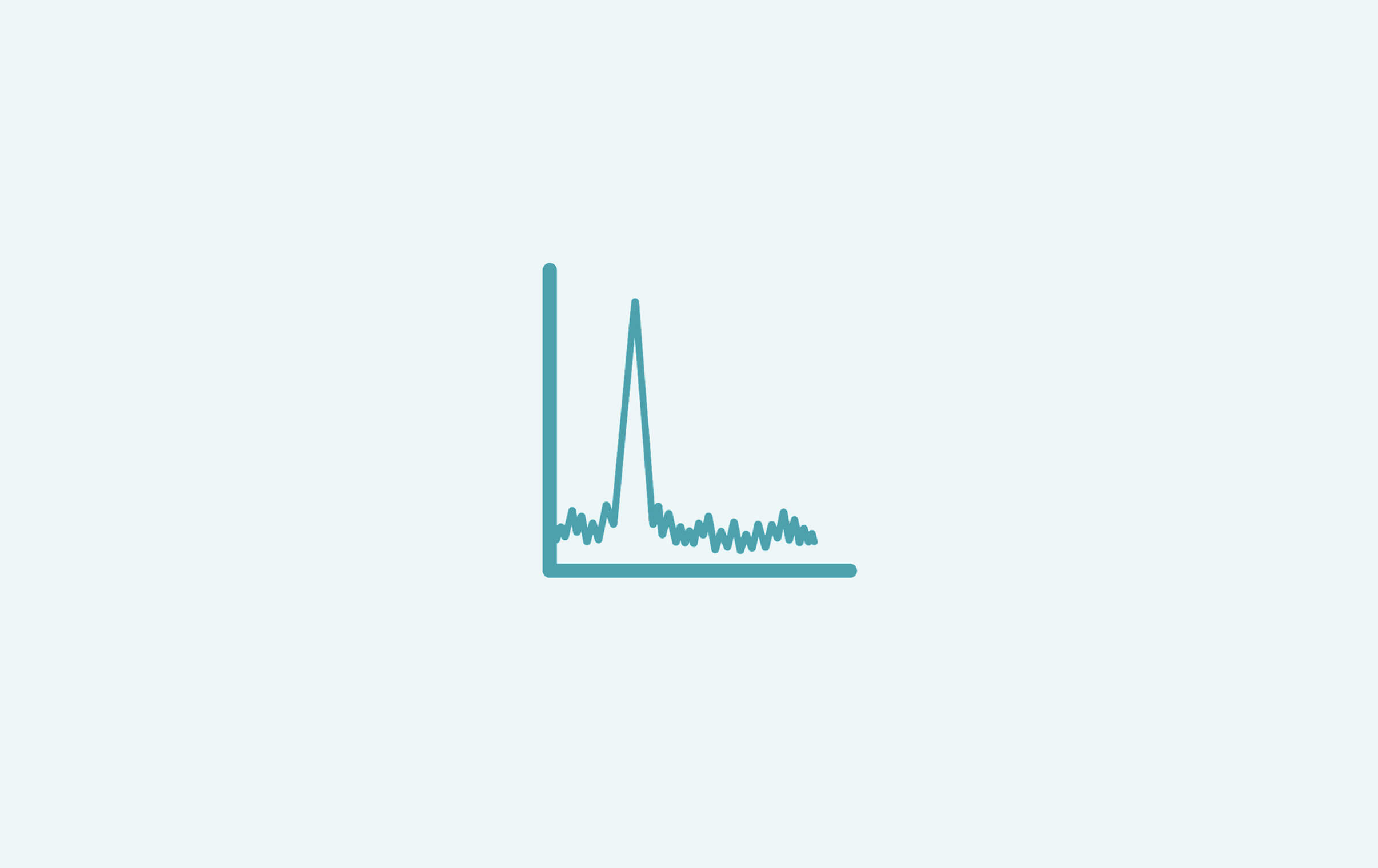
Several factors influence OCT spectrometer and system performance, including axial resolution, imaging depth, roll-off performance, signal-to-noise ratio, and measurement speed. These parameters guide the design of the Wasatch Cobra spectrometer product family.
Axial Resolution
The axial (depth) and transverse (lateral) resolution of an OCT system are independent. The axial resolution is related to the bandwidth, or the coherence length, of the source. For a Gaussian spectrum, the axial resolution (λc) is given by: λc = < 0.44λc2/
Δλ, where λ is the central wavelength and Δλ is the bandwidth of the source. It should be noted that this is the spectrum measured at the detector and may differ from the spectrum of the source, due to the response of optical components and the detector itself. The equation holds only for Gaussian spectra.
Imaging Depth
The image in SD-OCT is obtained after Fourier transformation of the spectral interference data; thus, the depth is limited by the finite number of pixels and optical resolution of the spectrometer.
A total bandwidth (Δλ) sampled by N pixels gives us a wavelength sampling rate of δλ = Δλ/N. Since a Fourier transform relates frequency to time, we can convert wavelength to frequency, δν = c*Δλ /λ2. The maximum imaging depth achievable in SD-OCT is: Zmax = 1/4 . λc2/(Δλ/N)
Roll-off Performance
In SD-OCT, sensitivity is dependent on the length of the reference arm. The maximum sensitivity occurs around the zero-delay difference point and decreases as we move away from the zero-delay point. This loss is the result of finite pixel size and finite optical resolution of the spectrometer, with the sensitivity decreasing with depth.
Where w is equal to δλ/Δλ and depends on the optical resolution of the spectrometer elements. The first term representing a sine function on the left-hand side of the equation is the result of finite pixels in the spectrometer. The second term relates to the finite optical resolution of the spectrometer that results in ‘leakage’ of a given wavelength into multiple pixels.
Signal to Noise Ratio (SNR)
The signal-to-noise ratio (SNR) is defined as the ratio of signal power to noise power. Because noise is statistical in nature, its power is characterized by its variance. In OCT, three main noise sources typically dominate:
Detector noise, mainly caused by thermal fluctuations in the light source output
Shot noise due to inherent variance in the arrival and detection of photons on the detector
Relative Intensity noise (RIN) from fluctuations in the light source output
An ideal system has minimal detector and intensity noise and operates in the shot-noise domain, and the performance is determined by the number of photons reaching the detector.
Speed
The speed of an OCT system depends on several factors. The first being the amount of light received on the detector. Speed is directly related to the time the system needs to accumulate enough photons for a good signal to noise ratio. The other limitations on speed are the system parameters themselves. For a spectrometer based spectral-domain OCT system the speed of the camera sensor and electronics are usually the limiting factor. With camera speeds now up to 250kHz, SD-OCT is on par with SS-OCT on speed of OCT image acquisition.
Additional Resources
1. Brezinski, Mark E., Optical coherence tomography: principles and applications, Elsevier, 2006.
2. Fercher, Adolf F., et al , Optical coherence tomography-principles and applications, Reports on progress in physics66.2 (2003): 239.
3. Swanson, Eric A., Fujimoto, James G., The ecosystem that powered the translation of OCT from fundamental research to clinical and commercial impact, Biomedical optics express 8.3 (2017): 1638-1664.
Misty Johnson is responsible for taking care of our grating customers at the Logan, Utah, facility. She has been a member of the Wasatch Photonics team since 2009. By understanding her customers’ needs and goals, as well as the current grating market, Misty is able to provide a superior level of customer support. As Account Manager, she acts as a liaison between customers and Wasatch Photonics’ manufacturing department making sure that the lines of communication are always open.
Customer support is an integral part of Wasatch Photonics commitment to customers. Whether you are in the market to purchase a single grating, inquiring as a distributor, or purchasing large volume, Misty will guide you seamlessly through the custom design process. Misty strives to build trust and strong long term relationships with Wasatch Photonics customers. She brings 20 years’ experience as customer support manager from a number of manufacturing and service companies.