An instantaneous point-and-shoot chemical analysis
About one century ago, C.V. Raman discovered that light scattered from molecules contained a ‘feeble fluorescence’ that carried information about the vibrational states of those molecules. Raman received the 1930 Nobel Prize in physics for this discovery, and the field of Raman spectroscopy was born.
Despite the challenges and limitations of the early experiments, technological advances of lasers in the 1960s and charge coupled detectors (CCDs) in the 1980s kick started the proliferation of Raman spectroscopy as a powerful spectroscopic technique.
What is Raman Spectroscopy?
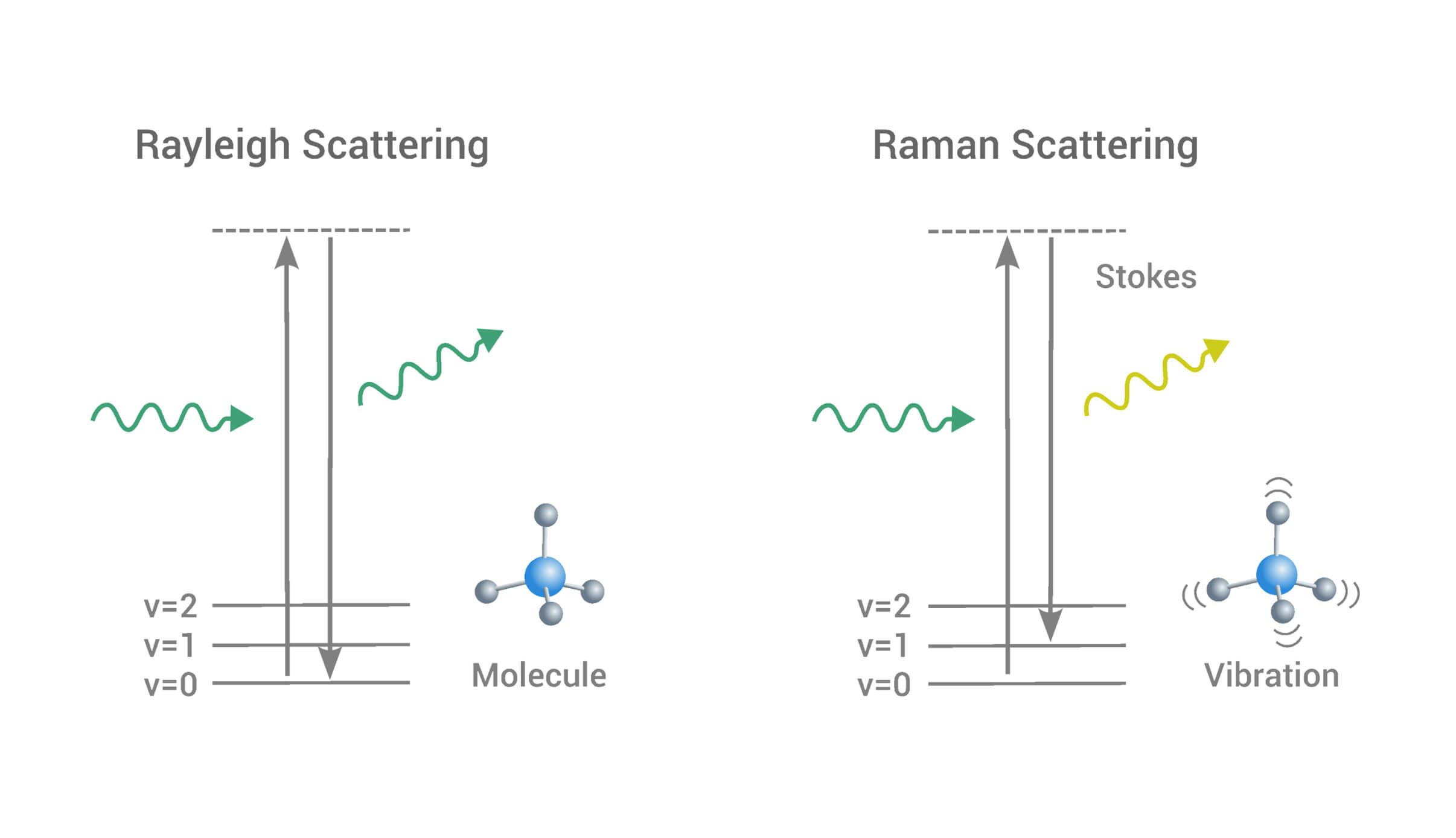
Raman spectroscopy is an analytical technique, in which laser light is scattered inelastically from a sample, yielding information about the vibrational states of the sample. In classical terms, when light interacts with molecules, the electron clouds of the sample resonate with the incident light. This interaction will usually emit the light unaltered as laser scatter, but there is a probability of one part in a million that the photon will exchange energy with the vibrational motion of the molecule. As a result, the scattered light shifts in wavelength, producing the effect known as Raman scattering.
The Raman Frequency Shift
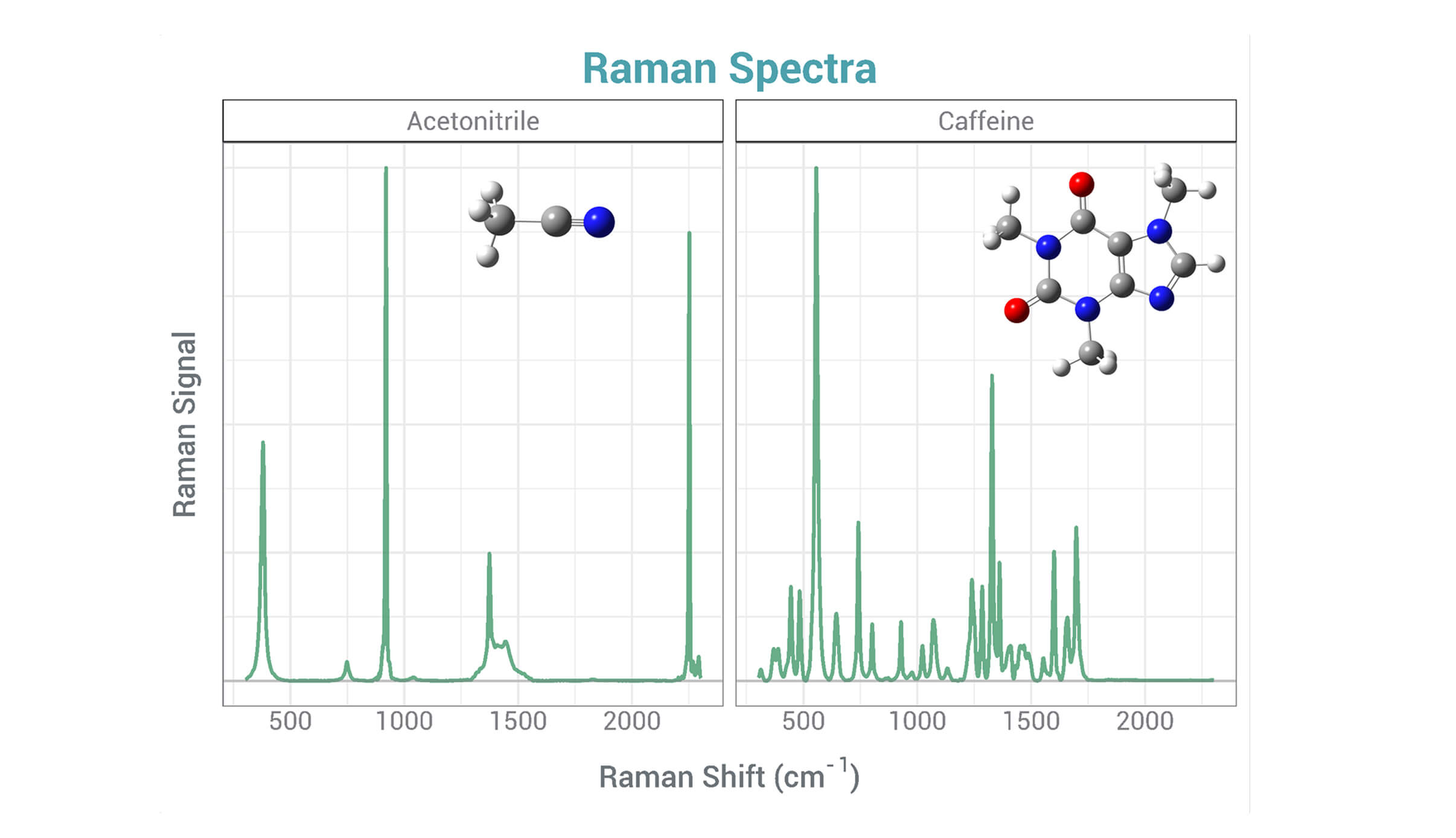
The exchange of energy between laser and molecular vibrations is not continuous: the energy transferred from the light needs to equal the energy of one of the distinct molecular vibrational frequencies. The frequency shift seen in the Raman-scattered light is thus very characteristic for a specific molecule. A typical Raman spectrum can consist of one or many such peaks. For simple molecules, like acetonitrile, the Raman spectrum may feature narrow and well-separated peaks, while for complex molecules, like caffeine, the Raman can be much more complex.
Wavenumbers
As the energy exchange between light and molecular vibrations leads to a frequency shift of the Raman scattering relative to the laser wavelength, this Raman shift is measured on a frequency scale, which is traditionally measured in ‘wavenumbers’, which is the number of full wavelengths that can fit inside a single centimeter, with the unit cm-1. Molecular vibrational frequencies are on about a few hundred to maybe 3500 in these units, which is a very ‘pleasant’ order of magnitude, so this traditional, somewhat unusual, unit stuck.
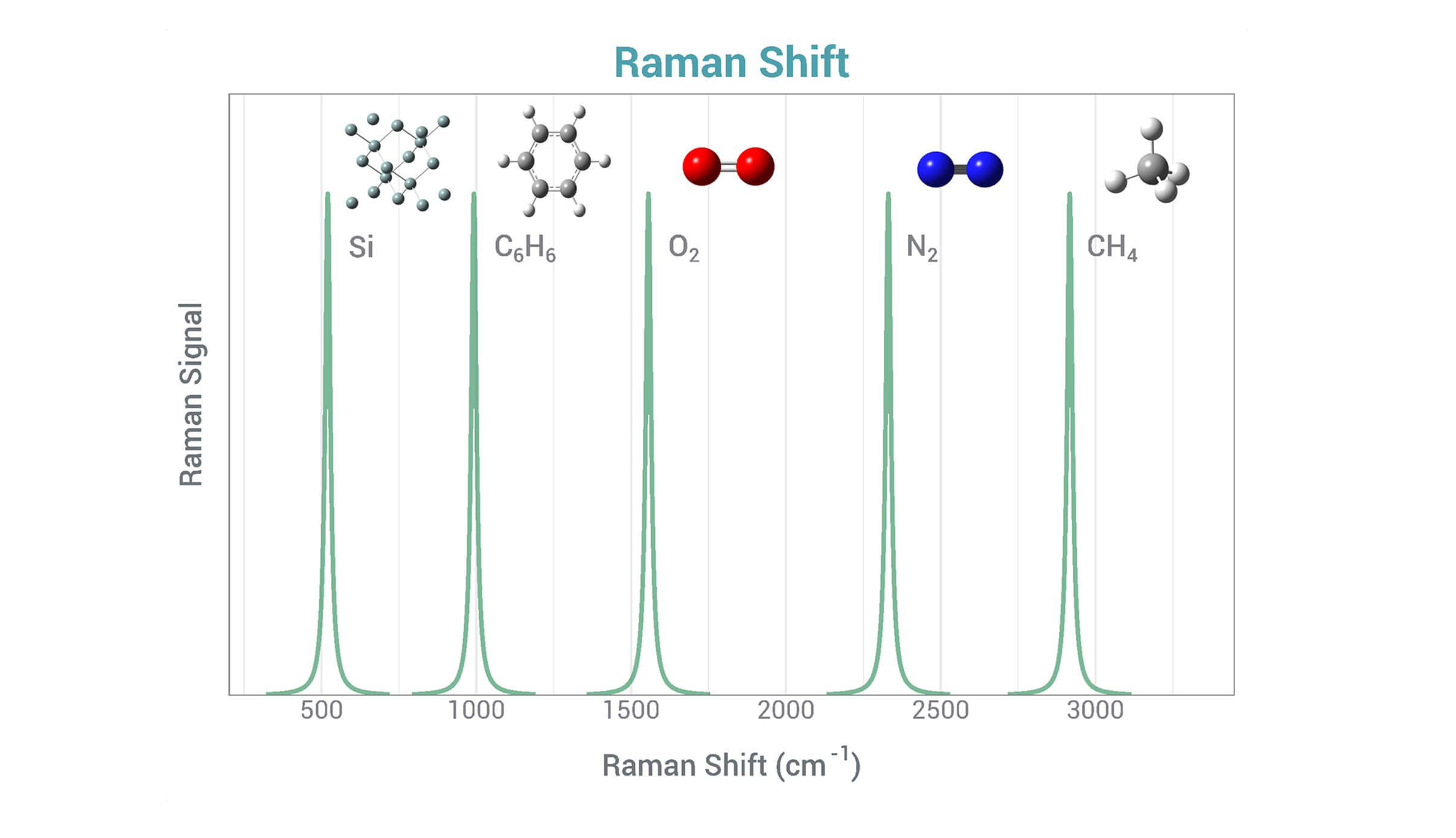
Conceptual illustration of Raman Shift
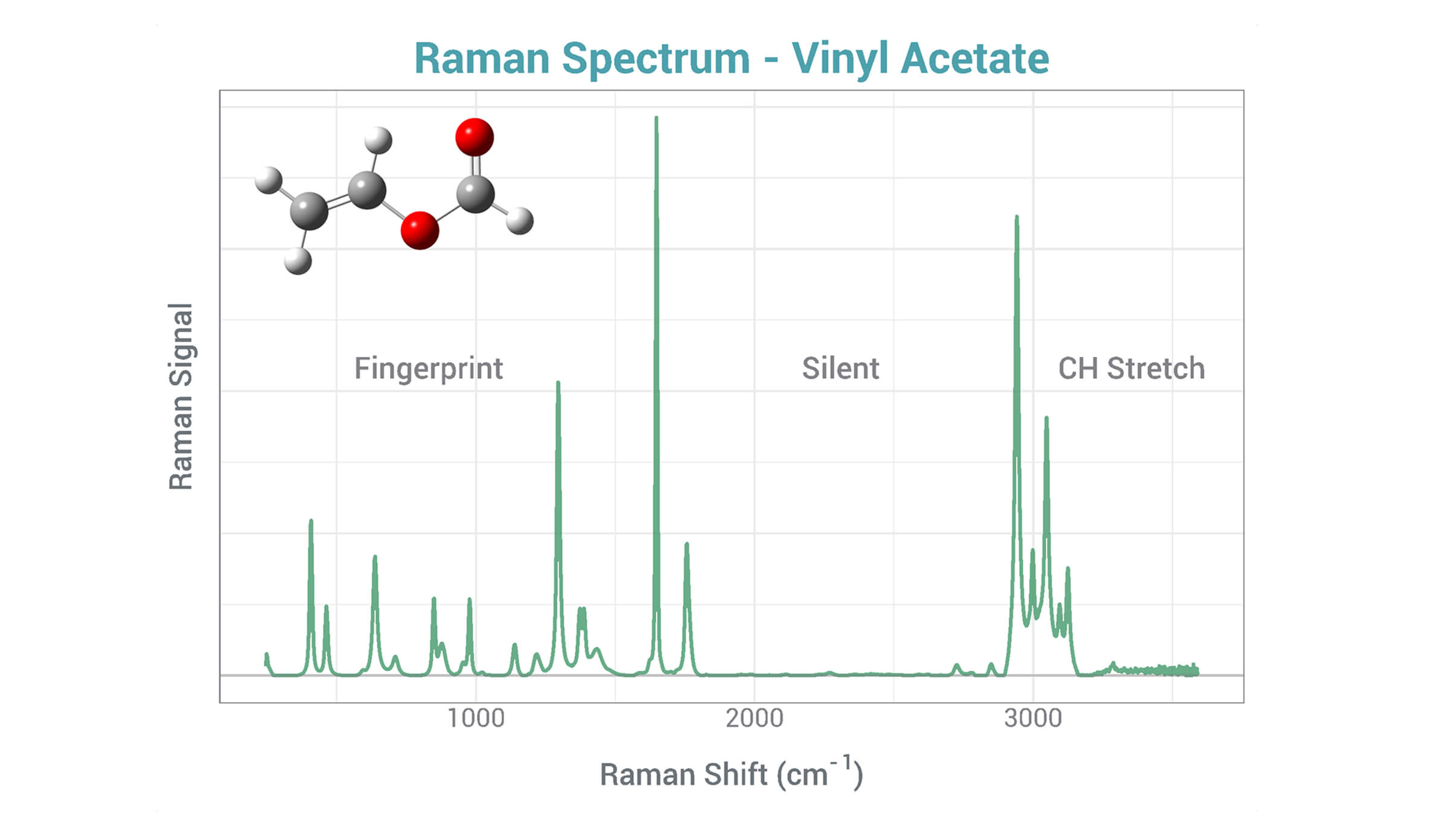
Example of different Raman Shift Regions
A Molecular Fingerprint
The Raman spectrum is so characteristic for a molecule that it is typically called a ‘fingerprint’. Likewise, the spectral region up to about 1800 cm-1 is known as the ‘fingerprint region’. The spectral region above 1800 cm-1 covers local molecular vibrations characteristic for specific functional groups and is hence called the ‘functional’ region. As only some uncommon bonds have peaks between roughly 2000 and 2900 cm-1, this region is also known as the ‘silent region’.
Raman vs FTIR
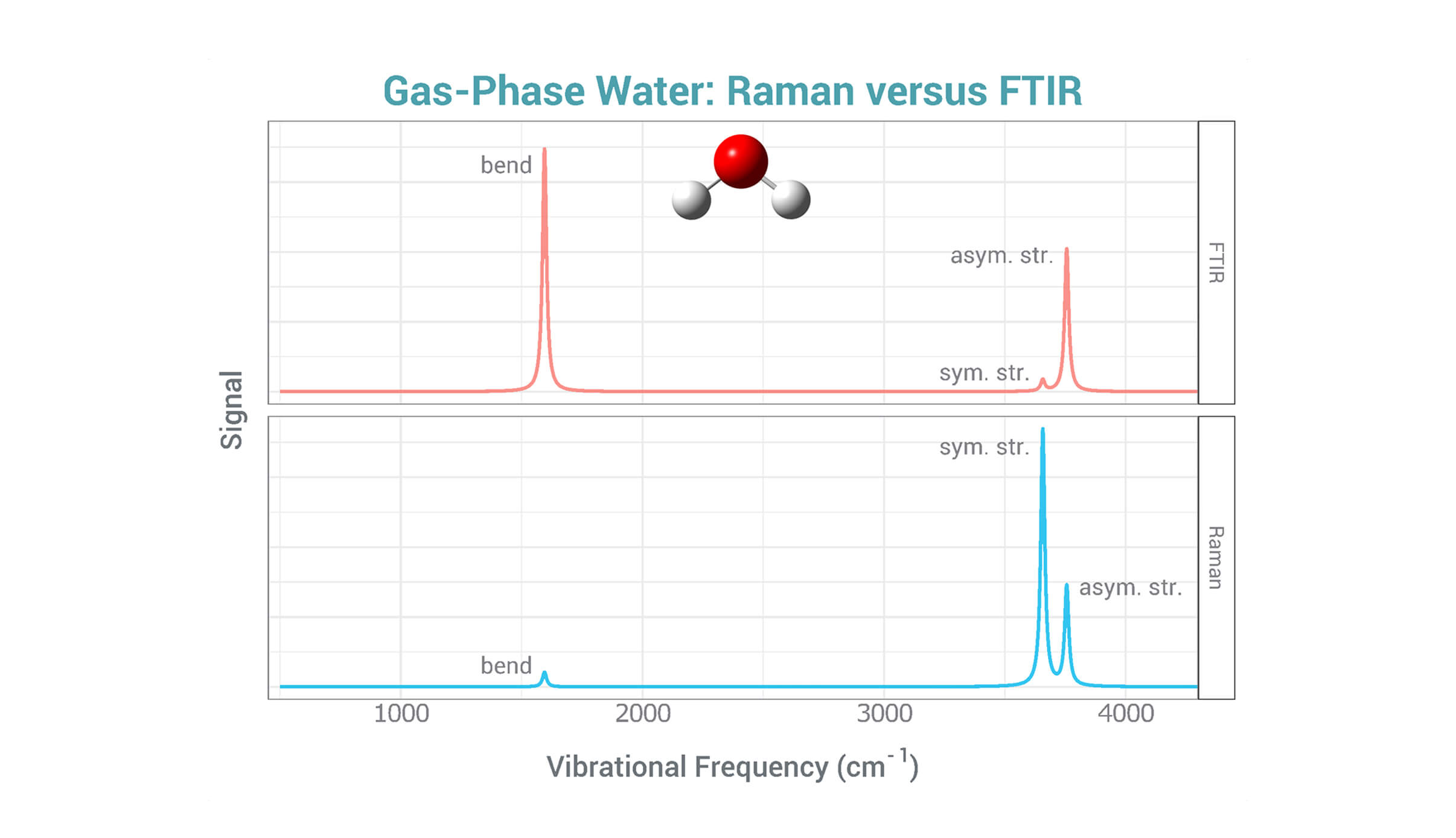
In Raman spectroscopy, light couples to vibrational changes in the polarizability of the molecule, which is complementary to infrared spectroscopy, in which light couples to vibrational changes to the molecular dipole moment. Both techniques provide information about vibrational frequencies of the sample, but differ in their sensitivity to specific molecular vibrations. Water, for example, with its strong dipole moment and low polarizability, has a strong infrared absorbance, but a very small Raman resonance.
Comparison of Raman and FTIR spectrum of water
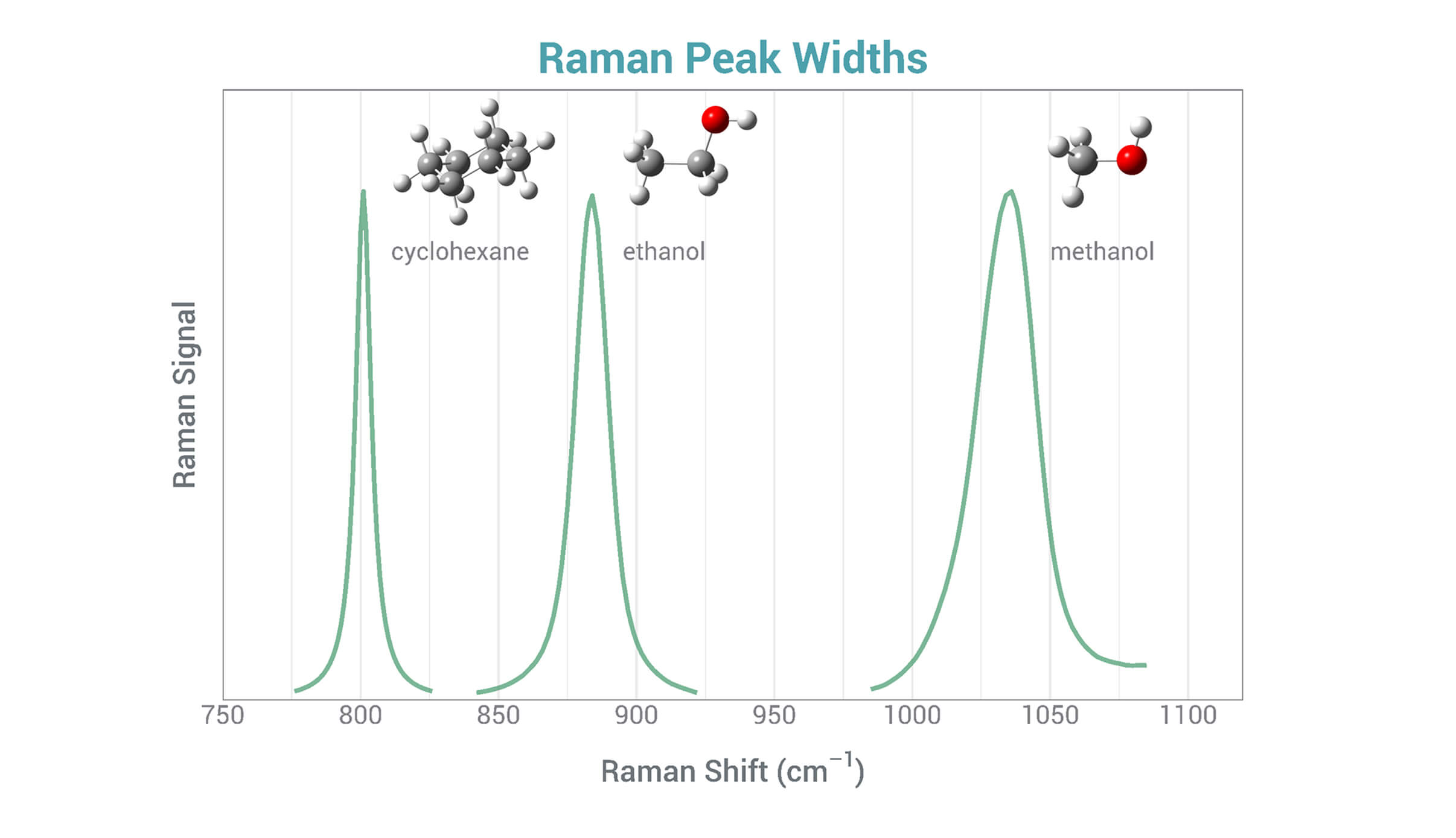
Examples of Raman bands of different widths
Raman Peak Widths
The widths of typical Raman peaks depends on the structure of the local molecular environment. Isolated molecules (like gases), crystals (like silicon) and a few select solids and liquids (like cyclohexane, benzene, or calcium carbonate) have narrow line widths, narrower than the resolution of typical spectrometers. However, almost all Raman bands of liquids and solids are broadened to a width of about 10-15 cm-1.
Laser Wavelength
In principle, Raman scattering occurs with any laser wavelength. The choice of laser wavelength, however, is a balance between various trade-offs.
(Auto-) Fluorescence excited by the Raman laser can overwhelm the Raman signal. Longer laser wavelengths (785, 830, 1064 nm) reduce this fluorescence
(Raman) Scattering increases with the fourth power of the laser frequency, a shorter laser wavelength therefore leads to stronger Raman signal
Different laser wavelengths require different lasers, with different output powers, sizes, and associated costs. 532 nm, for example, requires a stand-alone unit with lower power and higher cost than 785 nm
With Raman shift being a frequency scale, a longer laser wavelength leads to a reduced Raman spectral range, while simultaneously improving Raman spectral resolution
Different emission spectra require different detectors. Visible Raman spectra (excitation at 532, 633, 638 nm) work best with CCD or CMOS cameras, NIR wavelengths (785, 830 nm) require a NIR-enhanced CCD or CMOS detector, while for 1064-nm excitation one needs to switch to InGaAs detectors with lower sensitivity and higher dark signal
Special techniques, like near-resonant Raman, require an excitation wavelength in a specific wavelength region
Misty Johnson is responsible for taking care of our grating customers at the Logan, Utah, facility. She has been a member of the Wasatch Photonics team since 2009. By understanding her customers’ needs and goals, as well as the current grating market, Misty is able to provide a superior level of customer support. As Account Manager, she acts as a liaison between customers and Wasatch Photonics’ manufacturing department making sure that the lines of communication are always open.
Customer support is an integral part of Wasatch Photonics commitment to customers. Whether you are in the market to purchase a single grating, inquiring as a distributor, or purchasing large volume, Misty will guide you seamlessly through the custom design process. Misty strives to build trust and strong long term relationships with Wasatch Photonics customers. She brings 20 years’ experience as customer support manager from a number of manufacturing and service companies.