Gaining a detailed understanding of the chemical fingerprint, purity, or composition of your sample requires a highly sensitive spectroscopic solution. Raman spectroscopy is a powerful, non-destructive, non-contact technique capable of doing just that. It is ideal for comprehensive chemical identifications of various sample types and is particularly beneficial in applications where sample consumption during testing would represent a significant cost burden, or where water interference makes NIR impractical.
The field of Raman spectroscopy has opened up extensively since the onset of compact and even handheld systems that use laser modules and integrated detectors to acquire Raman spectra on the go. Now, users have the choice between fully-modular Raman systems, semi-integrated or fully-integrated spectrometers, OEM modules, and proprietary portable devices. But which type of Raman spectrometer is right for you?
Before we answer that, it is worthwhile recapping some of the basics of Raman spectroscopy in more detail.
Raman Spectroscopy 101: What You Need to Know
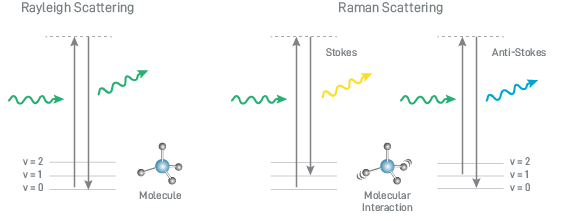
When high intensity laser light is incident on a sample it may be absorbed, reflected, scattered, or transmitted. Raman spectroscopy is a light scattering technique concerned with extremely weak signals that are scattered at different wavelengths to that of the incident beam. The intensity and energy of Raman scattering is expressed as a series of peaks which correspond to specific molecular subgroups. Individual chemical bonds have characteristic vibrations, which is how Raman scattering can be used to probe the chemical identity and phase of such a wide range of sample types.
Raman spectroscopy is performed by using a high-power laser to excite a molecule and observing the shifted spectrum of light that is scattered back. Most of the time, molecules scatter incident light without effect (Rayleigh scattering). But occasionally, before being scattered, the light interacts with one of the vibrations in the molecule and the photon subsequently loses (or gains) some of its energy. The light scattered will then be of a different wavelength to that which is incident on the molecule. This shift in photon energy matches the molecule’s specific vibrational frequency, which in turn is characteristic of the compound. Measuring the ‘fingerprint’ of shifts from many such photons interacting with the various possible vibrations, stretches, and bends within the molecule therefore provides accurate chemical identification of the compound in question.
Many more factors can influence the quality of a Raman spectrum, such as excitation wavelength, fluorescence background, and the impact of laser power, all of which are explored in our tech note Wavelength Matters. For the purposes of this simple introduction, it is enough to note that Raman spectroscopy demands high stability monochromatic laser sources and high-sensitivity, low noise optics that can rapidly acquire spectra with good resolution.
Raman Systems from Wasatch Photonics
In today’s world of constant innovation, the high-end benchtop Raman spectrometer is no longer the be-all-and-end-all of chemical screening in different applications. At Wasatch Photonics, we have deployed our extensive expertise in precision optics to the field of Raman spectroscopy, yielding a suite of solutions with sensitivity approaching that of much larger, more expensive benchtop systems for rapid acquisition of high-quality Raman spectra.
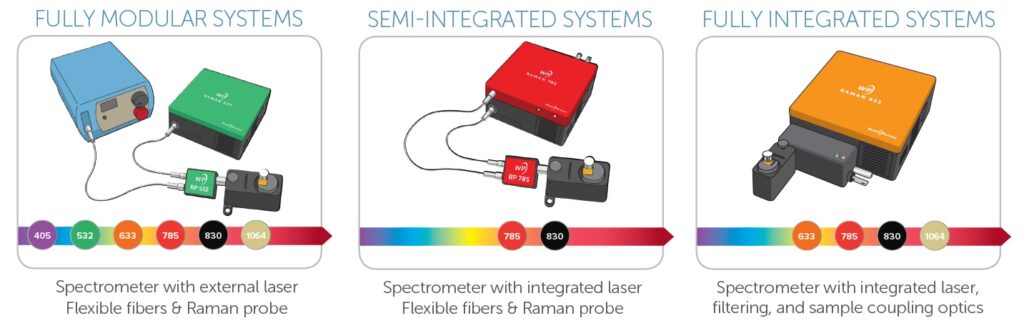
Additionally, we have leveraged that technical know-how with a product focus to offer several different system configurations to suit specific user needs:
Modular Raman System: Fiber optic connections link a portable spectrometer to an independent laser and probe, for maximum reconfigurability and sample types.
Semi-Integrated Raman System: A self-contained Raman spectrometer and laser unit with fiber-optic connections to an external probe for flexibility in a cost-effective, streamlined footprint.
Fully-Integrated Raman System: Completely self-contained unit with integrated sampling optics for greatest signal strength and software control in a compact footprint.
Refer to our quick system options overview for a deeper dive into the specifics of our individual Raman spectrometers. Or, if you have any specific questions for a member of the Wasatch Photonics team, why not contact us today?