
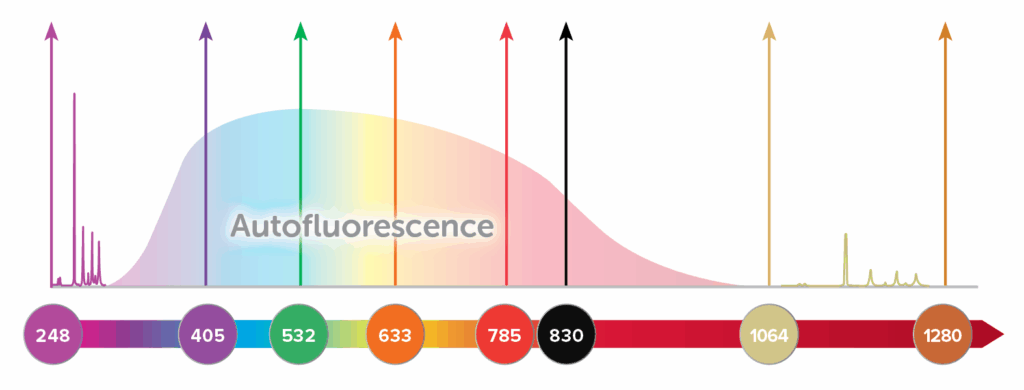
Raman spectroscopy requires a concentrated light source such as a laser to generate Raman signal from a sample, which is often referred to as a ‘Raman laser’ or ‘Raman excitation laser’. Its characteristics impact the quality of the Raman spectrum which can be acquired. This is why the lasers we offer are carefully selected based on their linewidth, stability, and power (learn more about these parameters below). Wasatch Photonics offers standalone benchtop lasers from several leading laser manufacturers for Raman spectroscopy (248 to 1064 nm), as well as a line of spectrometers and systems with integrated lasers, which offer unique benefits.
Any laser wavelength can be used to generate a Raman spectrum as long as sufficient laser intensity is delivered to the sample. However, there are trade-offs between wavelength and background autofluorescence that determine the best choice for each sample type. When we work with you to configure a Raman spectrometer or system, we aim to balance these factors for the cleanest, strongest spectra. Learn more in our tech note, Wavelength Matters.
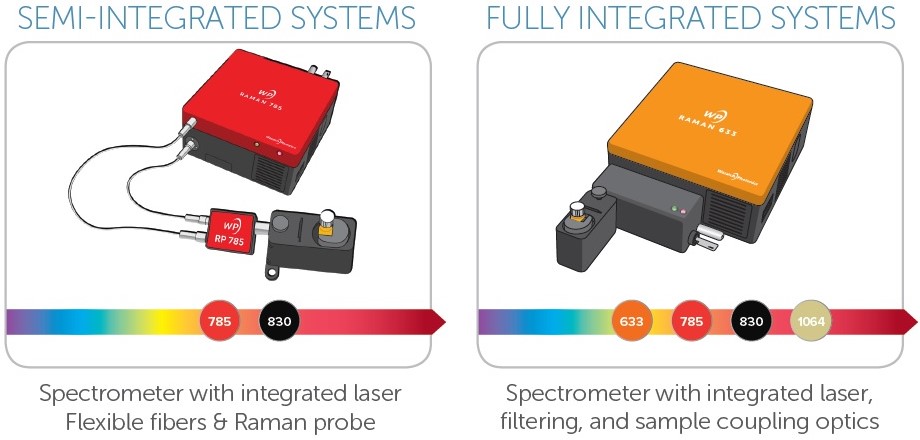
At Wasatch Photonics, we highly recommend using a Raman system with an integrated laser, as this reduces size & cost and allows full laser control via software. We offer an integrated laser option for most of our WP Raman series (WP 633, 785, 830, and 1064 nm), and for all of our OEM modules:  WP 785 XM, WP 830 XM, and WP 1064 X. Integrating the laser with the spectrometer in a Raman system offers many benefits over the use of a standalone or benchtop laser:
A semi-integrated Raman system combines the spectrometer and laser into a single unit to reduce footprint and cost, while separate connectors for each allow a fiber-optic Raman probe or other sampling optics to be used. This configuration maximizes value without sacrificing flexibility, and yields signal comparable to a fully modular system. Power and controls for the laser are provided through the spectrometer, simplifying cabling and allowing remote/automated operation.
A fully integrated Raman system brings the laser, sampling optics, and spectrometer together into one unit, eliminating coupling fibers to improve optical efficiency and mechanical durability. Communications and supply of power are also consolidated into a single, compact footprint with complete laser control through software or drivers. A fully integrated system delivers considerably higher signal thanks to the integration of all-free-space optics.
Some users prefer a fully modular Raman system for maximum flexibility, in which case we offer the benchtop lasers below for use with Wasatch Photonics spectrometers. Note that benchtop or standalone lasers are not directly controllable from our ENLIGHTEN™ spectroscopy software, nor is their wavelength automatically detected to calculate Raman shift accurately. For external laser power control, please refer to the manufacturer’s operating manual regarding availability of control software or SDKs. A 105 µm core multimode fiber (0.22 NA) is often used for lasers with an FC-PC output, but contact us to discuss the best fiber choice and system configuration for your specific application and needs.
| WP Part Number | Max Laser Power | Dimensions & Weight | Output Connector | Manufacturer & Model (click for datasheet) | Notes | Product Image | |
|---|---|---|---|---|---|---|---|

![]() | WP-248-SOL-70 | 70 mW | 100 x 100 x 700 mm, 3.6 kg | None (free space output) | Photon Systems NeCu70-248 | Pulsed operation, 1-20 Hz; visit manufacturer’s support page | ![]() |
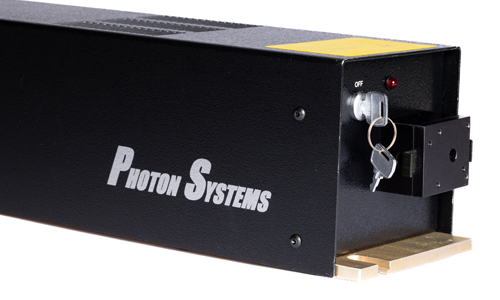
![]() | WP-532-SOL-50 | 50 mW | 166 x 118 x 94 mm, 1.45 kg (combined laser head + heat sink) | FC-PC, narrow key* | Hubner Photonics Cobolt 08-DPL HS-03 Heatsink | Power control via manufacturer software, visit manufacturer’s support page | ![]() |
![]() | WP-532-SOL-100 | 100 mW | 166 x 118 x 94 mm, 1.45 kg (combined laser head + heat sink) | FC-PC, narrow key* | Hubner Photonics Cobolt 08-DPL HS-03 Heatsink | Power control via manufacturer software, visit manufacturer’s support page | ![]() |
![]() | WP-633-SOL | 50 mW | 177 x 113 x 209 mm | FC-PC | Innovative Photonics Solutions I0633SL0050MF | Power control via USB, I²C, or RS-232; visit manufacturer’s support page | ![]() |
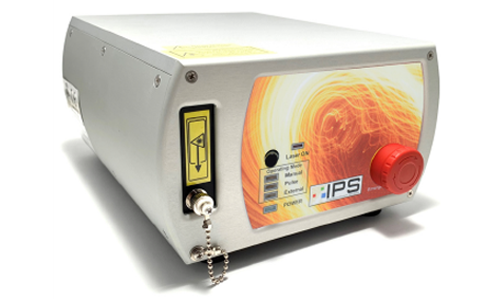
![]() | WP-638-SOL | 300 mW | 150 x 105 x 50 mm, <1 kg | FC-PC | Coherent BT-638 | Power control via RS-232; visit manufacturer’s support page | ![]() |
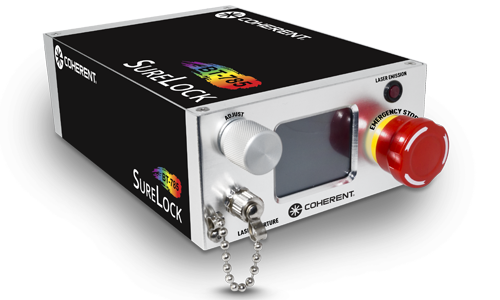
![]() | WP-785-SOL | 499 mW | 150 x 105 x 50 mm, <1 kg | FC-PC | Coherent BT-785 | Power control via RS-232; visit manufacturer’s support page | ![]() |
![]() | WP-830-SOL | 499 mW | 150 x 105 x 50 mm, <1 kg | FC-PC | Coherent BT-830 | Power control via RS-232; visit manufacturer’s support page | ![]() |
![]() | WP-1064-SOL | 499 mW | 150 x 105 x 50 mm, <1 kg | FC-PC | Coherent BT-1064 | Power control via RS-232; visit manufacturer’s support page | ![]() |
Are you using your own laser for Raman spectroscopy, or buying one as part of a system? You’ll want to make sure it is appropriate for the unique needs of Raman. Here are the parameters we consider to be most important at Wasatch Photonics, and what we look for in any Raman laser we resell, recommend, or integrate:
It is essential to know the exact emission wavelength of the laser used for Raman excitation, as the output wavelength of a Raman laser may vary by up to 1 nm from the nominal wavelength. This value must be used in order to calculate the Raman shift in cm-1 accurately. Even a small, 0.1 nm difference in laser wavelength can result in a 1-15 cm-1 shift in the Raman spectrum (depending on excitation wavelength).
All Wasatch Photonics Raman spectrometers and systems provided with an integrated laser (or purchased from us with a standalone/benchtop laser as part of a configured modular system) already have the exact measured laser wavelength stored in EEPROM, which will be read automatically by our ENLIGHTEN™ software to calculate Raman shift. Note: If you are using any other laser, ENLIGHTEN™ software will assume that the laser wavelength matches the nominal excitation wavelength corresponding to the spectrometer in use (i.e., 785.0 nm for a WP 785 spectrometer). If you wish to write your own laser wavelength to a Wasatch Photonics spectrometer EEPROM, contact technical support here.
We also advise performing a daily wavenumber correction to adjust for small changes due to temperature or laser drift. To learn more about this, read our tech note, Reproducible Raman Measurements, or consult the wavenumber correction section of the ENLIGHTEN™ software manual.
When you are using a Raman spectrometer with an integrated or standalone laser, it is extremely important to follow all recommended safety precautions. You should also complete your organization’s laser safety training course, or seek one out independently. At a minimum, any Raman system operator should: