- Raman Excitation Wavelength
- Fully Modular, Semi-Integrated and Fully Integrated Raman solutions
- Spectral Range
- Detector Cooling
- Standard vs OEM models
- Raman Probes
Type of Applications:Â Raman Applications
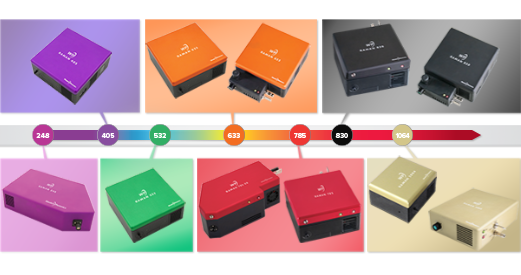
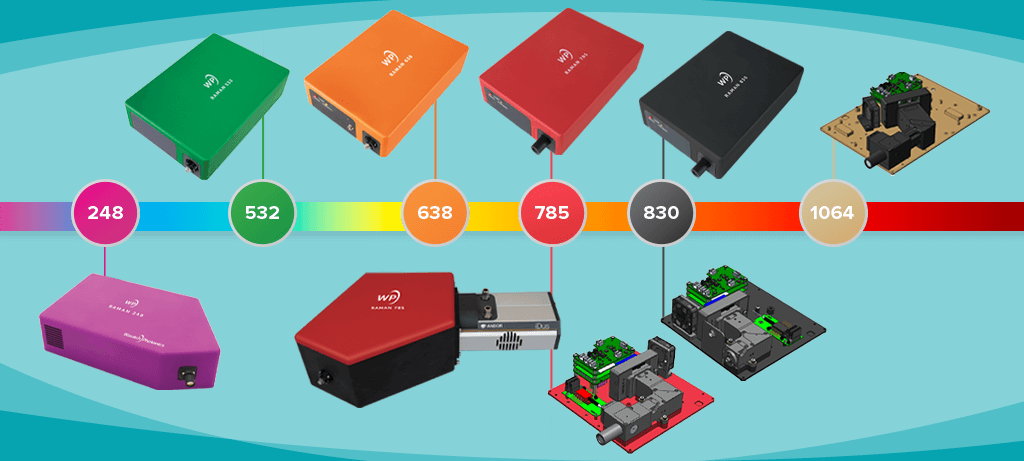
Wasatch Photonics offers Raman spectrometers from 248 – 1064 nm, as well as a variety of compatible probes and commercially available lasers .
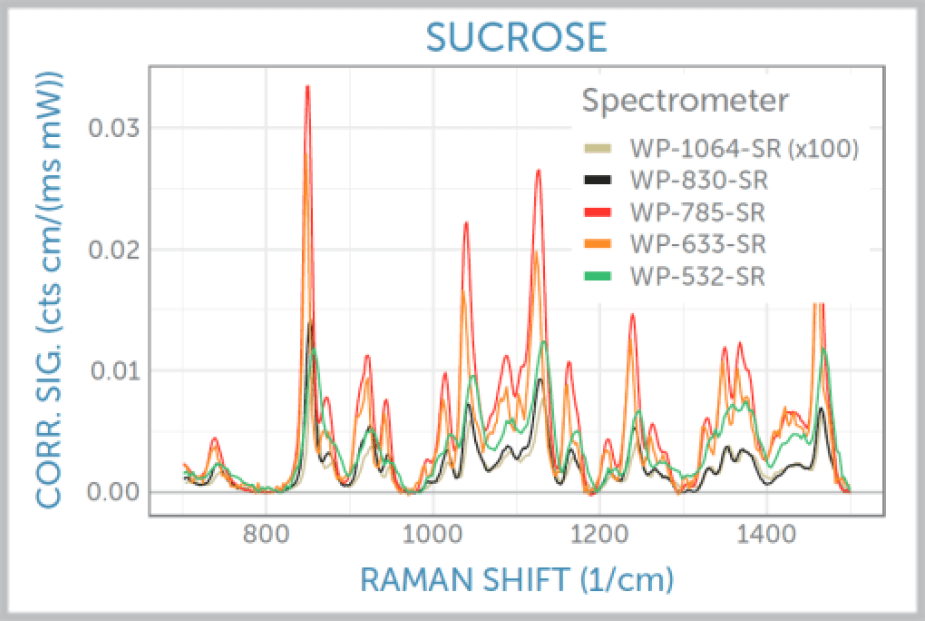
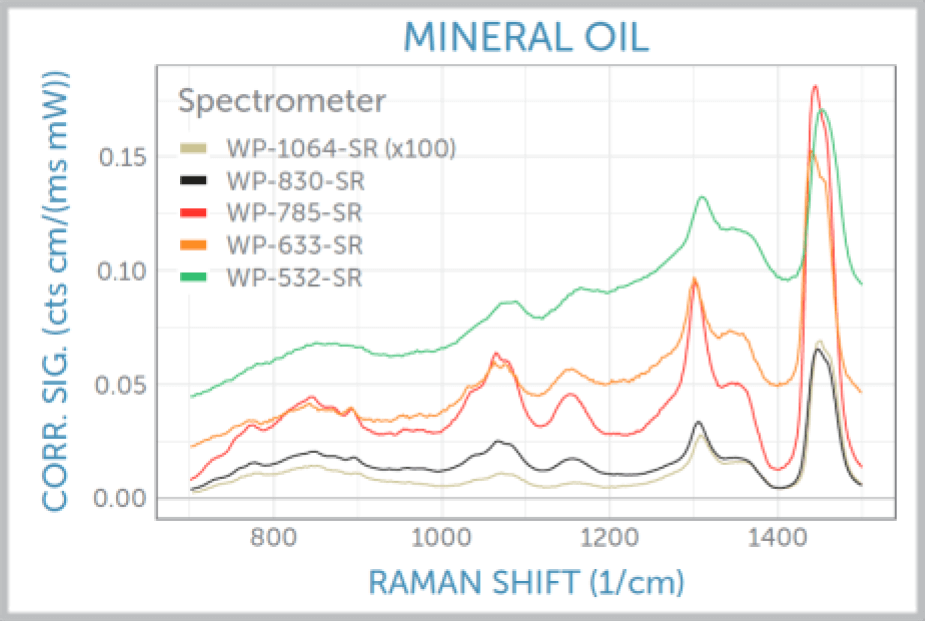
The choice of excitation wavelength is key in designing a Raman experiment, with the material of interest determining the optimal laser choice. This can be seen here, with 785 nm excitation delivering the most signal for sucrose, and 1064 nm excitation leading to the lowest fluorescence background in mineral oil.
For the past few years we’ve been working with our growing customer base to offer them the Raman spectrometers and systems to satisfy a diverse range of needs: plastics identification, authentication of spirits, medical diagnostics, quantifying hydrocarbons on-site during drilling, and detection of bacteria using nanoparticle-based SERS. By way of overview, here are some examples of applications served by the different excitation wavelengths we offer.
We know that some customers already have their own lasers, or they seek to control that aspect of their supply chain as an OEM – this means we can provide the customer with a fully modular solution. For those customers that seek a more compact solution but still desire the flexibility in sampling of a Raman probe we offer a semi-integrated solution. Here the laser is housed in the spectrometer body and is a fully software-controlled solution complete with FDA safety requirements built in.
Our most compact and most powerful product offering also incorporates the Raman probe into the spectrometer thereby offering a fully integrated solution. In this design the optical throughput is even greater than the more modular setup, however, this comes at the expense of reduced sampling flexibility.
Wasatch Photonics offers product covering both the fingerprint region (which goes up to about 1800 cm-1) and extended fingerprint and functional group range (to 3600 cm-1). Depending on the molecules of interest, each spectrometer has its merit.
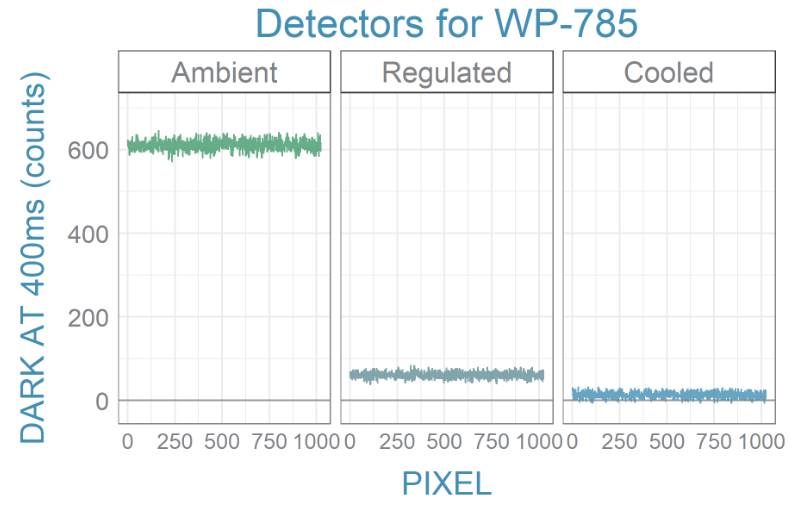
Depending upon the use case and cost targets, we offer a choice of detector cooling options to suit the needs of the customer. Ranging from the uncooled (lowest cost, highest electrical noise), cooled to 10°C (medium cost and noise) and cooled to -15°C (highest cost, lowest noise) we have an option to fit your requirements, and will consult with you to find the best fit for your application and goals.
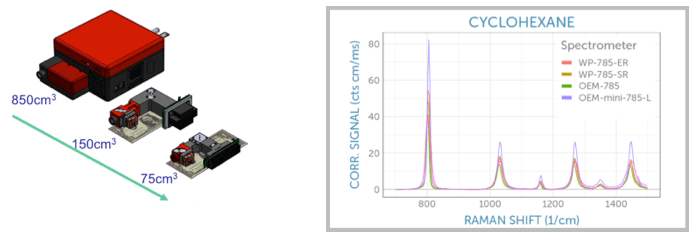
Wasatch Photonics’ optical benches and off-the-shelf spectrometers use the same high sensitivity optical design and mechanical bench, and thus have similar performance. This allows you to perform proof-of-concept testing or method development on our benchtop models, then transition easily to our lightweight OEM models with no loss of performance or need to requalify. We call this approach ‘OEM by design‘.
We understand that for many OEM customers, our spectrometers must mechanically fit into a predetermined space and as such, we pride ourselves on tailoring the footprint of the spectrometer when needed to meet these demands with minimal compromise to spectroscopic performance – in most case no compromise at all!
Â
Wasatch Photonics has also continued to expand its offering of Raman probes, each with matched NA to the spectrometer but optimized for the end user needs. Our probes offer the ability to change out the imaging and collection barrel to allow operation at very short focal lengths, as well as standard laboratory probe lengths and pharmaceutical ready immersion probes.
What comes next? That’s the exciting part, as you get to play a role in that process. Our innovations most often start with needs you’ve expressed – some tool or capability that is limiting your research or product development. So contact us today to talk about what you’d like to see next. Who knows? We may already have a prototype to answer that exact need.
Dr. David Creasey, CEO of Wasatch Photonics, is a PhD chemist with over 25 years of expertise in spectroscopy and optical innovation. He combines deep technical knowledge with strategic leadership to drive the development of high-performance photonic solutions for research, industry, and medical applications. He has authored numerous peer-reviewed publications in atmospheric chemistry, Raman spectroscopy, and VPH grating technology.
Cicely Rathmell, MSc is a seasoned science communicator and marketing professional with a strong academic background in chemistry and physics and over 25 years of experience in the photonics industry. As VP of Marketing at Wasatch Photonics, she applies her technical expertise and industry insight to make advanced spectroscopy and optical technologies accessible and impactful for researchers and innovators.