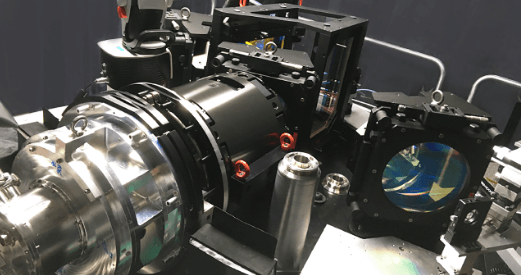
4MOST Sees First Lab Light: we are delighted to share that the 4MOST instrument destined for the VISTA telescope at ESO in Chile has achieved two key milestones – demonstration of first lab light for its low and high resolution spectrographs. Wasatch Photonics supplied all 9 VPH gratings used in the 4MOST instrument, working with teams at the Centre de Recherche Astrophysique de Lyon (CRAL) and the 4MOST Consortium since 2016 on their design, development, and manufacture.
An Eye for All the Sky
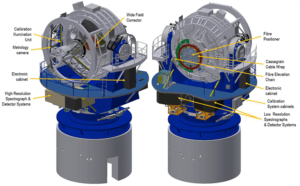
4MOST is a wide-field, high-multiplex, fiber-fed spectrograph, which will be mounted on the VISTA telescope at the ESO Paranal Observatory in Chile. What’s unique about 4MOST is that the instrument has been designed to carry out multiple surveys simultaneously, allowing it to observe large sample sizes for different science programs in parallel. This will make it possible for research groups from all over the world to observe surveys which would otherwise be too expensive due to the low density of their targets.
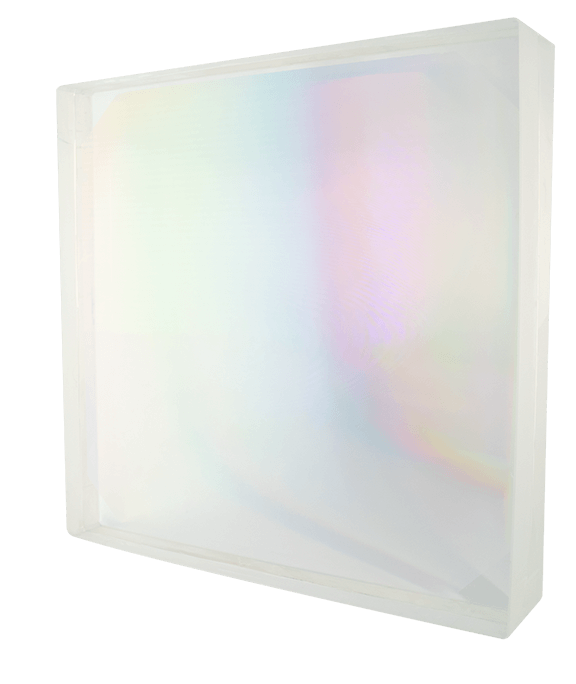
The Wasatch Photonics VPH gratings used by 4MOST are >25 cm on a side!
4MOST Spectrograph Design
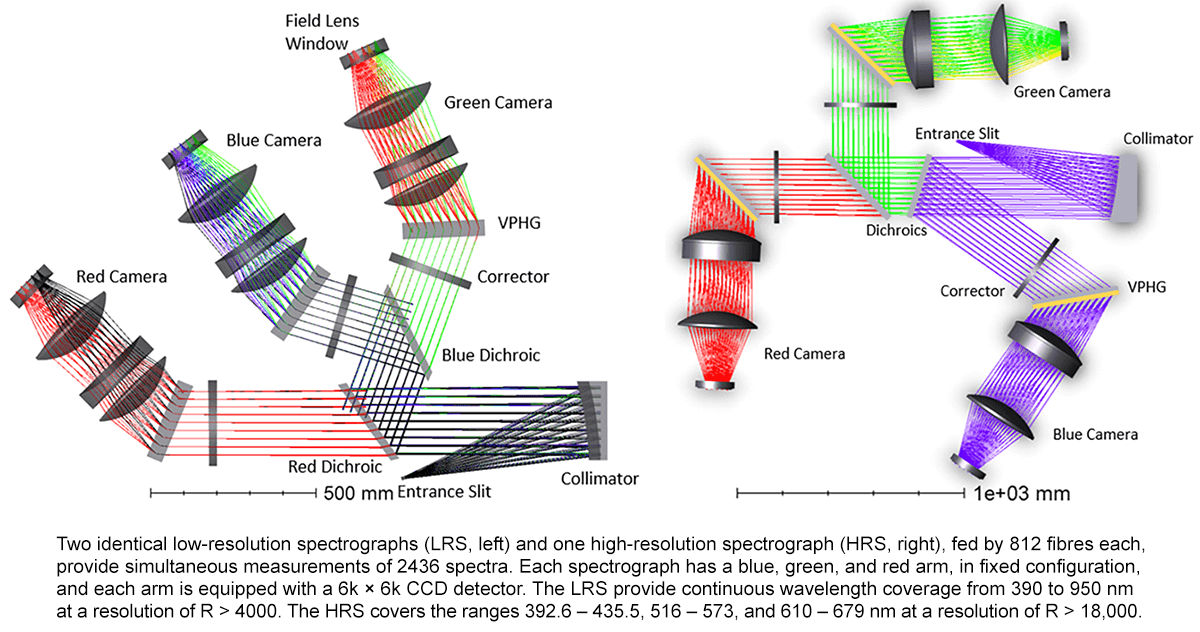
To facilitate this goal, 4MOST includes two low resolution spectrographs (LRS) and one high resolution spectrograph (HRS). These are fed by a total of 2436 fibers placed at the telescope focus, with a 2.6° diameter field-of-view. Of these, 812 fibers go to each of the three spectrographs, where the light is further split by dichroics into blue, green, and red channels. The three channels of the LRS are dispersed using VPH gratings to provide continuous coverage over the range 390-950 nm, at a resolution of R > 4000. The three HRS channels cover 392.6-435.5 nm (blue), 516-573 nm (green), and 610-679 nm (red) respectively, at a resolution of R > 18,000.
“First Lab Light” Successful for HRS & LRS
“First light” is a term used to describe when a telescope or astronomical spectrograph is first illuminated. Collection of “first light” in the lab (i.e., first spectra) is an important milestone in the testing of any new spectrograph, as the results are used to determine whether the image quality, wavelength range, and spectral resolution are as designed, and therefore whether the instrument will ultimately be able to achieve its scientific objectives. Given the multi-year journey from concept to testing for an astronomical instrument, it is an exciting milestone indeed.
The blue arm of the LRS-A bench which enabled the first LRS “lab light”, courtesy of Alban Remillieux, CRAL.
First lab light for the high resolution spectrograph (HRS) green channel occurred in December, 2020. The project team were able to complete alignment and achieve most specifications within just a few days, validating the overall 4MOST opto-mechanical design (read full details here). First spectra for one of the low resolution spectrographs (LRS-A) have more recently been taken using the blue channel (March 2021), demonstrating initial performance very close to its scientific and technical specifications (details and spectra here). These results give the 4MOST team confidence that similar performance will be achieved when assembling the remaining channels in the instrument, and set the stage for true “first light” at the VISTA telescope in 2023, using the very stars themselves.
Seeing into the Past, and Predicting Galactic Futures
4MOST’s mandate at the VISTA telescope will be to provide spectroscopic data to compliment the large-area surveys coming from key European space missions and ground-based facilities. The instrument’s design allows tens of millions of spectra to be obtained in a 5-year survey, even for targets distributed over large portions of the sky. This will allow 4MOST spectra to address a broad range of pressing scientific questions in the fields of galactic archaeology, stellar physics, high-energy astrophysics, galaxy evolution, and cosmology. Read more about the planned surveys
We wish the 4MOST team success as they continue testing and integration of the instrument, and look forward to all the wonderful science to come!
Laurent, Florence, et al. “4MOST low resolution spectrograph MAIT.” Ground-based and Airborne Instrumentation for Astronomy VIII. Vol. 11447. International Society for Optics and Photonics, 2020.
Caillier, Patrick, et al. “4MOST low resolution spectrograph final design.” Ground-based and Airborne Instrumentation for Astronomy VII. Vol. 10702. International Society for Optics and Photonics, 2018.
Author: Cicely Rathmell, MSc
Cicely Rathmell, MSc is a seasoned science communicator and marketing professional with a strong academic background in chemistry and physics and over 25 years of experience in the photonics industry. As VP of Marketing at Wasatch Photonics, she applies her technical expertise and industry insight to make advanced spectroscopy and optical technologies accessible and impactful for researchers and innovators.